

There’s been a recent influx of job listings from AI companies and prominent tech voices looking for six-figure positions for writers, storytellers, and curators of taste (e.g., Dwarkesh’s search for writers for his podcast, Tyler Cowen’s Call for New Aesthetics, Anthropic and OpenAI’s search for well-paid Head of Content roles). Why is the demand for human talent spiking, if not in quantity then in quality, in a world inundated with AI?
These are signals toward a renewed emphasis on taste, that while production has become table stakes, curating the right sort of content will now give you an edge. Tech writer Anu from Working Theory puts it well:
“In a world of scarcity, we treasure tools. In a world of abundance, we treasure taste.”
Taste is the ability to tell whether or not something looks good or feels right, an intuition shaped through multiple acts of judgement. Fundamentally, as Nietzsche says, “all of life is a dispute over taste and tasting”; our personal tastes are an expression of our morals, values, culture, upbringing — highly individual. Pierre Bourdieu writes that while taste feels personal, it is reinforced and learned by communities and institutions (echoed by some tech writers about how objective taste calibrates around communities).
Perhaps reframing taste from the dichotomy of relativism vs. absolutism, it’s more appropriate to think of good taste as a finely tuned mechanism for judgement. Paul Graham famously writes in his essay about good work that it is simple, timeless, solves the right problem, suggestive, symmetrical, resembles nature, daring, a redesign, and done in communities. Short of meeting each of these criteria individually, good taste is instead about identifying the pattern: the ability to navigate tension.
Good taste thrives on contradiction, rather than resolution. It is timeless yet reflective of its time, it speaks to culture without being mainstream, and it is an original imitation. By nature of being a delicate balance between one quality or another, swaying into neither fully, good taste is a skill to be honed. The practice of developing good taste — a thinning funnel, a tightrope, the discipline of stone stacking — also lives in tension. It is a practice of two distinct yet complementary ways of living: consuming deliberately and producing excessively.
Consume deliberately
If you were learning how to cook just 30-40 years ago, you would peruse books at a physical location. 10-20 years ago, you’d search for recipes online. Today, you only need to think about cooking before short-form content platforms push streams of unwarranted, and not necessarily unwanted, recipes your way. As digital touch points become more and more integrated with our lifestyles, the less we seek information proactively. Where information is disseminated so effectively and so gratuitously, consumption is at risk of becoming meaningless abundance.
But it’s more than simply combatting passivity: how many of your choices do you actually own? And how many of your choices belong to a greater network channeling all the fingerprints you have left in the digital world? When algorithms coalesce into recommending the same things — due to profitability, popularity, or controversy — it is becoming increasingly difficult to diverge from the mainstream. When the business of advertisement is so closely plugged into our thoughts and preferences, predicting our next engagement before we’re even aware, data becomes a control mechanism for our decisions. As popular chatbots begin launching advertising functions, the advent of AI is allowing platforms to learn more about you and push content more seamlessly.
Far from adopting a completely Luddite lifestyle, it’s perhaps more realistic to practice cognitive security, commonly used to mean protecting the mind against misinformation. I argue it is also the methodical practice of discerning if you own the information pipeline and the act of extracting significance and intention to content you consume.
An act of deliberate consumption effectively gives the brain training data on previous works of art, so that the next time you encounter something analogous, you’ve already begun developing thoughts and opinions. It trains the muscle for identifying good and relevant art; it trains taste-making.
Produce excessively
I wrote about how lifestyles designed around convenience have smoothened our lives, away from things that require effort. Downstream of this is the preference for consumption hobbies, or passive engagement with art and media (e.g., reading, watching T.V., going out to eat), over production hobbies, or active engagement that begets creation (e.g., writing, knitting, cooking). While deliberate consumption has the potential to be creative input, being actively involved in the production of something, especially art, is a more effective way of curating your taste because it exposes you to feedback.
I enjoyed this essay by artist Elliot Nathan (How to Make A Living) that mentions how finding your audience goes hand-in-hand with finding your style. Setting aside the equivalence that good taste is profitable art, I do agree that good taste goes beyond what simply speaks to your soul. It is also understanding what speaks to others; by extension, also allowing your art to reverberate with the cultural zeitgeist because if you “just make art that excites you…you eventually make work that resonates with people.”
In addition to experimenting with different styles, experimenting with derivative work is particularly salient: good work is rarely the first-of-a-kind. Instead, good work is constantly making iterative and additive Frankensteins of Good Work Past, especially exploratory, out-of-ordinary ones.
“It is only the unimaginative who ever invent. The true artist is known by the use he makes of what he annexes, and he annexes everything.” (Oscar Wilde)
It is also in this process of producing excessively that one can begin to better understand how to consume, not just out of self-preservation, but out of creative necessity.
Good taste is tension
Just as the definition of good taste resides in a tension — an art piece that is at once personal yet universal, one-of-a-kind yet familiar — so does the path of curating good taste.
The modern, unprecedented scale of accessible art and creation can be a beautiful thing; it allows us to understand what is possible, and get closer to what we truly like. It is discovery that not only feels limitless, but also prescient. Sometimes we tread closely to having too much of a good thing, a portent to choose balance and restraint.
Therein lies the tension that those with good taste understand how to navigate: consumption without production is passive, and production without deliberate consumption is wanting of context.
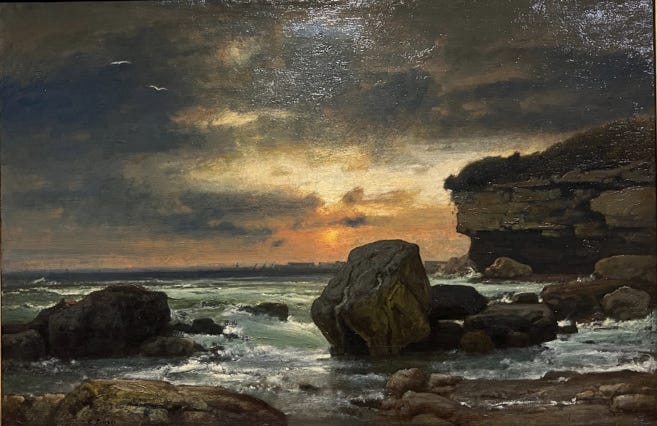
Very impressive!