

For the fifth year in a row (see 2024 here), I’ve reflected on my top reads alongside the prevailing themes that shaped them.
This year, I was infatuated with modernist literature and its in-depth exploration of the interior. The Sun Also Rises brings Hemingway’s “iceberg” technique at the forefront — flat writing that entrusts the reader in extracting rich expression under the surface. Woolf’s iconic stream of consciousness is dense in To the Lighthouse, where time is non-linear and plot takes a backseat in favor of delving into the complexity of each character’s subjective experience. Henry James’ Daisy Miller makes the most of storytelling through a biased and restricted POV, adding to the ambiguity and magnetism of the titular protagonist.
If modernist techniques frame the interior as the primary site of meaning, that interior becomes more charged when filtered through the woman’s perspective across history. Anna Karenina by Tolstoy is a dense psychological exercise on how societal norms and external judgement can invade the mind. Edith Wharton’s Age of Innocence reaches toward a similar freedom (more on this later), while The Ghost Stories of Edith Wharton are beautifully entertaining and serve their own moral reckoning. A book that surprised me this year was The Silent Woman by Janet Malcom, who meditates on the life of poet Sylvia Plath, but also the responsibility to truthfully yet artistically tell someone else’s story.
Science fiction is my favorite genre, but this year I leaned closer toward speculative fiction — centering humanistic debates before theorizing on scientific and technological progress. War of the Worlds was a taste of H. G. Wells’ lasting impact on invasion genre sci-fi, but also the foreboding analogy on the effect of total warfare. I Who Have Never Known Men by Jacqueline Harpman mysteriously confines our protagonist in a cage with 40 other women, where her interiority becomes a survival mechanism. My wildcard read of the year was Fevre Dream by George R. R. Martin, who disguises a philosophical inquiry of complicity in his epic of vampires on Mississippi steamboats in 1850s Jim Crow era.
A few other books that don’t quite fit in any pattern except to relive the writing of past favorites that never disappoint include Joan Didion’s Year of Magical Thinking, her detached precision in writing only adding to the feeling of experiencing insurmountable grief; Toni Morrison’s talent in exploring morality through complicated friendships in “Recitacif”; and a long-awaited prequel to the Hunger Games series that dominated my childhood, Suzanne Collins’ Sunrise on the Reaping.
I write mini-reviews of all books I’ve read on Goodreads; in the meantime, here are my top 3 of 26 books I’ve read in 2025, a combination of how much a book has entertained me, if I’ve learned something interesting from it, and how thoroughly the prose sank into my soul:
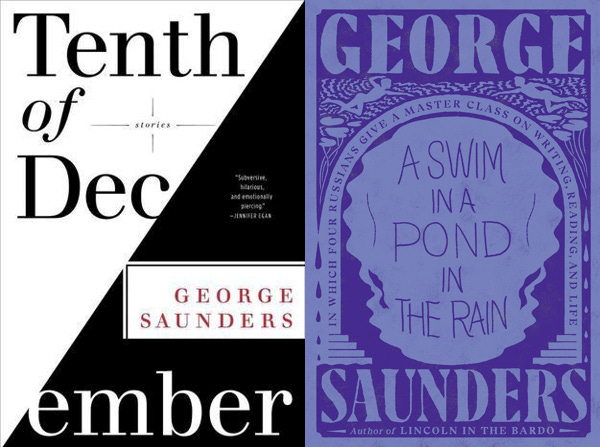
1. Tenth of December: Stories (2013) and A Swim in the Pond in the Rain (2021) by George Saunders
Genre: Tenth of December - Speculative fiction, Short stories; A Swim in the Pond in the Rain - Literary analysis, Nonfiction
Favorite quotes:
“It was that impossible thing: happiness that does not wilt to reveal the thin shoots of some new desire rising from within it.” - Tenth of December
“This feeling of fondness for the world takes the form, in [Chekhov’s] stories, of a constant state of reexamination.” - A Swim in the Pond in the Rain
“We don’t have to become an entirely new person to do better; our view just has to be readjusted, our natural energy turned in the right direction” - A Swim in the Pond in the Rain
Thoughts:
This year I picked up Saunders for the first time, and the two books I read instantly floated to the top of my favorites list, making it an impossible task to choose one over the other. The first, Tenth of December, is a collection of darkly clever short stories with sci-fi elements. Some stories are ordinary at first glance — struggles with money, mental illness, and trauma; others are experimental and odd — immigrant women being exploited as lawn ornaments, drugs that make you fall in hypomanic love or go on Medieval tirades. All share the use of humor to deal with serious topics and a constant window into characters’ inner monologues, creating uncomfortable yet deeply honest portrayals of life.
Saunders has one of the strongest voices in modern literature; his edgy yet effusive personality also comes through in the second book of his I picked up this year: A Swim in the Pond in the Rain, a guided reading of seven short stories of world-renowned Russian literature. As a writing professor, Saunders leads us through why select storytelling has persevered in literary canon for so long, covering Tolstoy, Chekhov, Turgenev, and Gogol. The later we get into the lesson, Saunders’ class-in-a-novel becomes less about writing and more about connection and life, which, in my opinion, is ultimately what good writing best captures.
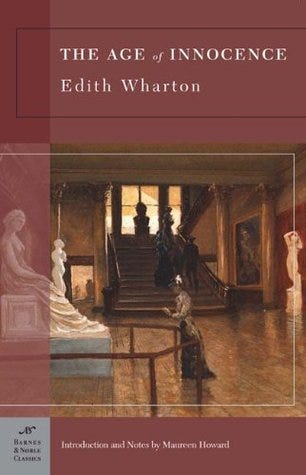
2. The Age of Innocence by Edith Wharton (1920)
Genre: Literary fiction
Favorite quote:
“Do you know - I hardly remembered you?… I mean: how shall I explain? I-it’s always so. Each time you happen to me all over again.”
Thoughts:
Wharton is another author who has charmed me thoroughly this year; as a wealthy, educated New York socialite during the Gilded Age (1870s), she has a piercing and stylish perspective on the societal constraints on even the most privileged women of her era. The Age of Innocence is the great American novel on the scandals, rituals, and undertones of a suffocating, high context culture.
If Anna Karenina is Russia’s Great Love Story, this novel is its American cousin — love stories constrained by reputation, social liability, and a suppression of authentic passion. I am enamored with the way Wharton writes about how love creeps up on you, how it’s brighter in memory, and how terrifying it can become when it threatens structures that make life legible. Ellen Olenska, the female protagonist, is endlessly compelling throughout the novel — an enigmatic, tortured, and worldly character that embodies “what could’ve been.”
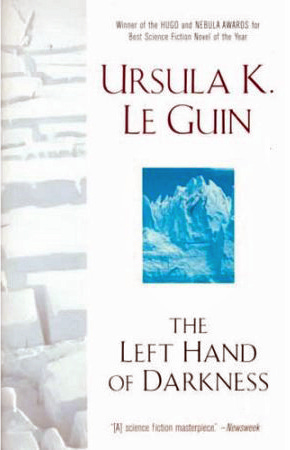
3. The Left Hand of Darkness by Ursula Le Guin (1969)
Genre: Speculative fiction
Favorite quote:
“It is a terrible thing, this kindness that human beings do not lose. Terrible, because when we are finally naked in the dark and cold, it is all we have. We who are so rich, so full of strength, we end up with that small change. We have nothing else to give.”
Thoughts:
Le Guin is masterful at plunging you into the depths of a frozen alien world “Winter” where the inhabitants are ambisexual (i.e., shifting genders on a monthly cycle) through the eyes of a human ambassador. The absence of sexual dimorphism is a riveting thought experiment; it exposes how gendered expectations shape power, intimacy, and even language. How does society reorganize itself when gender becomes a fluid construct? What is the moral labor we must undergo to better understand one another?
It is no surprise Le Guin has cemented herself as one of the most influential science fiction authors by contributing not just humanistic, grounded prose but also through raising philosophical questions about remains when every other identifier falls away — a fragile kindness.
Honorable Mentions:
“Yes, I need you, my fairy-tale. Because you are the only person I can talk with about the shade of a cloud, about the song of a thought — and about how, when I went out to work today and looked a tall sunflower in the face, it smiled at me with all of its seeds.”
Vladimir Nabokov, Letters to Véra
“Now I was trying only to reconstruct the collision, the collapse of the dead star.”
Joan Didion, The Year of Magical Thinking
“The mood of efficiency, of checking things off the list as you tear through a days shopping, washing, cleaning, mending and so forth, is totally destructive of the slightly bored melancholy which nurtures my imagination.”
Janet Malcom, The Silent Woman: Sylvia Plath and Ted Hughes
“It is awfully easy to be hard boiled about everything in the daytime, but at night it is another thing.”
Ernest Hemingway, The Sun Also Rises
“… grief and this joy were equally outside all ordinary circumstances of life, were like holes in this ordinary life, through which something higher showed.”
Leo Tolstoy, Anna Karenina
“It was love…love that never attempted to clutch its object; but, like the love which mathematicians bear their symbols, or poets their phrases, was meant to be spread over the world and become part of the human gain.”
Virginia Woolf, To the Lighthouse
“But isn’t this how souls come together, by holding another’s every idea to be true and making it their own?”
Sabahattin Ali, Madonna in a Fur Coat
Special shoutout to the book club that has accompanied many of these reads and happy holidays!
beautiful picks, beautiful reflections!
I love this. I love how your writing captures the essence of these books, I love your picks, and I love the quotes. Can’t wait to read all these